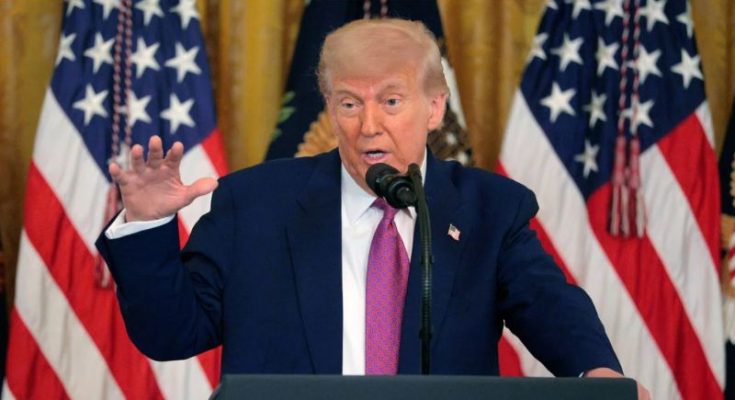
President Donald Trump said Tuesday that Iran has offered the United States a major concession tied to global energy markets, signaling a potential opening in ongoing negotiations amid high regional tensions. Speaking from the Oval Office, Trump described the development as a significant breakthrough but declined to provide detailed specifics.
“They gave us a present and the present arrived today, and it was a very big present, worth a tremendous amount of money,” Trump said. He clarified that the concession is not nuclear in nature, but instead relates to oil and gas, calling it “a very nice thing they did.”
Trump linked the move to discussions about Iran’s influence on energy markets and the strategic Strait of Hormuz, a critical chokepoint through which roughly one-fifth of the world’s traded oil flows. “We’re talking to the right people,” the president said, adding that Iran “wants to make a deal very badly.”
The announcement comes amid a volatile standoff in the region, where Iranian activity in and around the strait has disrupted tanker traffic and contributed to instability in global oil prices. Recent U.S. assessments warned that mining and attacks on commercial vessels caused a steep decline in maritime transit through the corridor.
Previously, the Trump administration issued a 48-hour ultimatum, demanding Iran restore normal shipping or face military action, including potential strikes on energy infrastructure. On Monday, Trump said he would delay those strikes for five days, citing “productive conversations” with Iranian officials. The extension appears to have created room for renewed diplomacy, with countries such as Pakistan and Egypt expressing willingness to act as intermediaries.
Trump emphasized that any agreement would hinge on preventing Iran from acquiring a nuclear weapon, repeating that denuclearization remains the top U.S. priority. At the same time, the administration has expanded military deployments in the region, including naval and Marine assets, marking what officials describe as the largest buildup since the 2003 Iraq War. The increased presence is intended to maintain flexibility and deter escalation while talks proceed.
Balancing that show of force, Trump repeatedly stressed he does not intend to commit U.S. ground troops, stating, “I’m not putting troops anywhere and if I were, I certainly wouldn’t tell you. But we will do whatever is necessary.”
While the president suggested the confrontation with Iran may be moving toward resolution, he stopped short of announcing a formal agreement. Energy markets and international observers remain closely focused on the Strait of Hormuz, as any disruption—or breakthrough—could immediately affect fuel prices, shipping, and regional stability.
For now, U.S. officials view the reported concession as a positive signal, though negotiations remain ongoing and contingent on further commitments from Tehran.