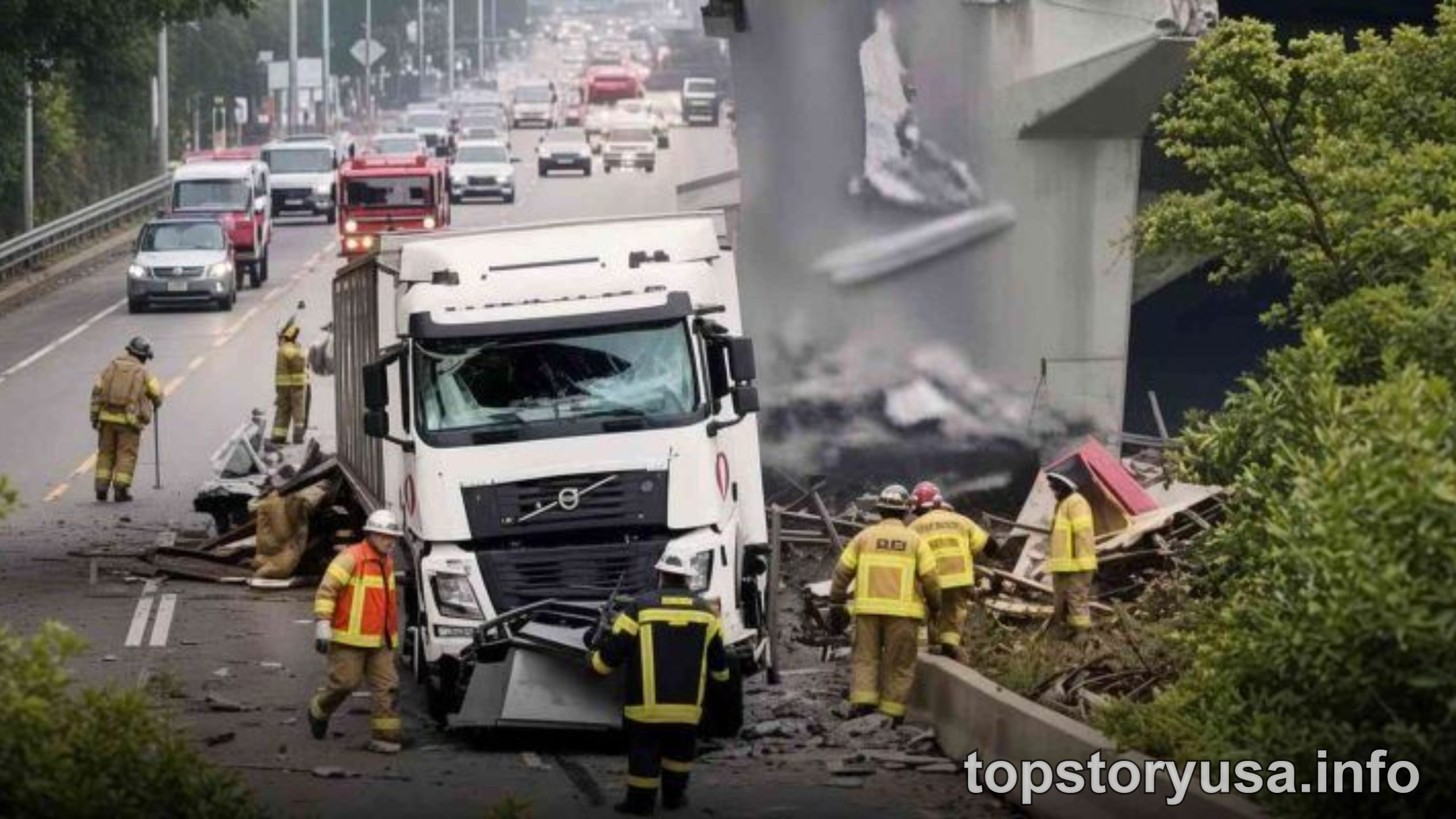
A commercial truck collided with an overpass on Knight Street in Richmond, British Columbia, Friday morning, forcing a full closure of southbound lanes and triggering a structural inspection.
The crash occurred around 7:15 a.m. Pacific Time when a truck towing a raised dump trailer struck the Cambie Road overpass. The trailer became lodged against the concrete span, and the force of impact detached the truck cab from the trailer.
No injuries were reported, but the collision prompted immediate concern about the bridge’s structural integrity. City and provincial engineers arrived on site to evaluate potential damage before reopening the roadway.
What Happened
According to investigators, the commercial vehicle was towing a dump trailer in a raised position when it attempted to pass under the structure. The trailer failed to clear the overhead span and struck the overpass, becoming wedged against it.
The City of Richmond confirmed that while Knight Street falls under provincial jurisdiction, municipal engineers joined the investigation to support the Ministry of Transportation and Infrastructure. Police advised motorists to seek alternate routes, acknowledging heavy congestion caused by the closure.
The Richmond Road Safety Unit took over the investigation, working closely with the provincial ministry to conduct a detailed structural and engineering review. Their examination included checking for cracks, joint displacement, or weakened support beams caused by the impact.
A Growing Pattern
This collision was not an isolated incident. In recent years, several commercial vehicles have collided with overpasses across the Lower Mainland and Fraser Valley, according to provincial data showing a rising pattern of over-height trucks striking bridges and infrastructure.
Last year, a similar crash occurred in Langley, marking the eighth such collision on provincial highways in a single year. These accidents often share a common cause: raised truck beds, improperly measured loads, or inadequate awareness of height restrictions.
While driver error remains a significant factor, industry experts stress that the problem also reflects aging infrastructure and inconsistent signage. The province’s database of bridge and overpass strikes cites several incidents in which clearance signs were missing or inaccurate, or where resurfacing work reduced vertical clearance available to passing vehicles.
Prevention and Safety Measures
The British Columbia Trucking Association has urged authorities to adopt a more comprehensive safety approach. The organization argues that technology such as over-height detection systems using laser or infrared sensors should be installed at key locations to warn drivers before reaching low overpasses.
Fleet operators are being reminded to improve training protocols. Drivers should verify trailer bed positions, check height limits before travel, and ensure that hydraulic or dump mechanisms are fully secured.
Transportation engineer Dr. Steven Fong of the University of British Columbia noted that while these technologies are valuable, they must be part of a broader safety ecosystem, saying “No single tool can eliminate accidents-effective prevention depends on a culture of accountability shared between drivers, fleet operators, and highway authorities.”
Other proposals include integrating clearance databases directly into GPS navigation tools for truck drivers, reducing reliance on manual signage. Structural engineers emphasize that thorough evaluation is critical not only for public safety but also for preventing future failures that could be far more costly to repair.
Regional Impact
The closure of a key artery such as Knight Street Bridge created ripple effects throughout the region’s transportation network. Richmond serves as a central hub for commercial trucking between Vancouver, Delta, and the Fraser Valley.
A prolonged closure delayed deliveries, increased fuel costs, and disrupted logistics operations. For local residents, the event added hours to commutes as vehicles diverted to secondary routes like No. 5 Road and Shell Road.
Each overpass collision not only risks structural damage but also causes financial strain for both government and private companies through repair costs, downtime, and insurance claims. Repair estimates for similar overpass incidents in British Columbia have reached into the millions, often funded by both insurance and public infrastructure budgets.