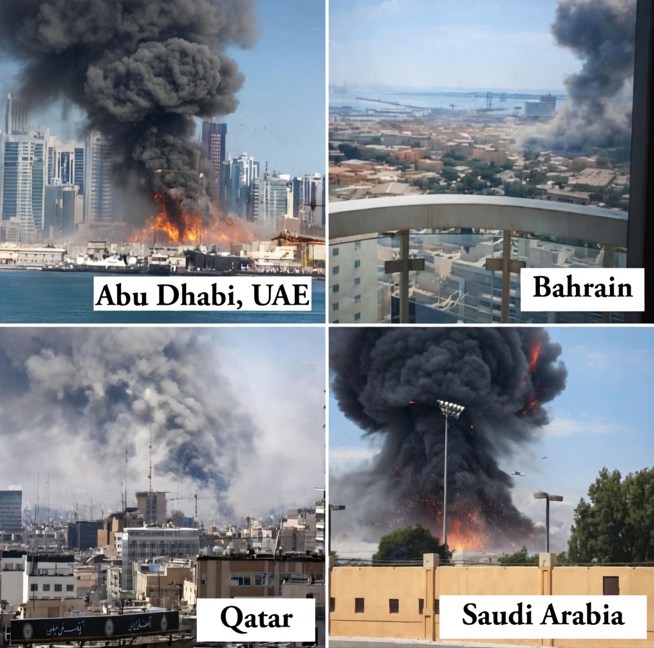
Tensions across the Persian Gulf have intensified following reports that Iran launched coordinated attacks on U.S. military installations in several countries. Iranian state television, citing military officials, claimed responsibility for the strikes, which allegedly targeted key bases and strategic sites throughout the region.
In the United Arab Emirates, a large explosion was reported in Abu Dhabi, raising concerns about a direct hit on Al Dhafra Air Base. Authorities responded swiftly by closing the country’s airspace and advising residents to remain indoors and avoid areas near military facilities. Emergency services were placed on high alert as officials began assessing potential damage.
In Bahrain, the Al Jufair district—home to the U.S. Fifth Fleet—was also affected. Witnesses reported smoke and loud explosions as air defense systems attempted to intercept incoming missiles. Local authorities urged citizens to stay inside and follow safety instructions while the situation remained uncertain.
Qatar experienced a similar scare when a missile reportedly targeted Al Udeid Air Base. According to the Defense Ministry, the threat was successfully neutralized by a Patriot missile defense system. The government declared a state of heightened alert, shut down its airspace, and instructed residents to shelter in place as a precaution.
Kuwait also reported explosions, with officials activating air defense systems in response to possible missile threats. Citizens were advised to remain at home and avoid unnecessary travel while authorities worked to ensure public safety.
The developments highlight a sharp escalation in regional tensions and raise fears of a broader conflict. Governments across the Gulf are closely monitoring the situation, while the international community is urging restraint. Residents are being encouraged to stay informed, follow official guidance, and prioritize their safety as events continue to unfold.